Law enforcement agencies have more training options than ever. Online courses can make training easier to schedule, reduce travel, provide consistent information, and give personnel access to learning regardless of shift or location.
Instructor-led training requires a different investment of time and resources.
So which approach is more effective?
The answer depends on what the training needs to accomplish.
Online training can efficiently deliver information. But when the objective is to change behavior, improve decision-making, develop leaders, strengthen communication, or practice interpersonal skills, information alone may not be enough.
Effective law enforcement training should prepare people not only to understand a concept, but to use it when the situation demands it.
What Makes Law Enforcement Training Effective?
Effective training begins with a clear outcome.
Instead of asking only whether personnel completed a course, agencies should ask:
What should they be able to do differently because of the training?
For some subjects, the desired outcome is knowledge. Personnel need to understand a policy, learn a procedure, receive an update, or become familiar with a new concept.
Other outcomes require more. Leadership requires communication and judgment. De-escalation requires the ability to recognize circumstances and respond appropriately. Supervision requires coaching, accountability, conflict management, and decision-making.
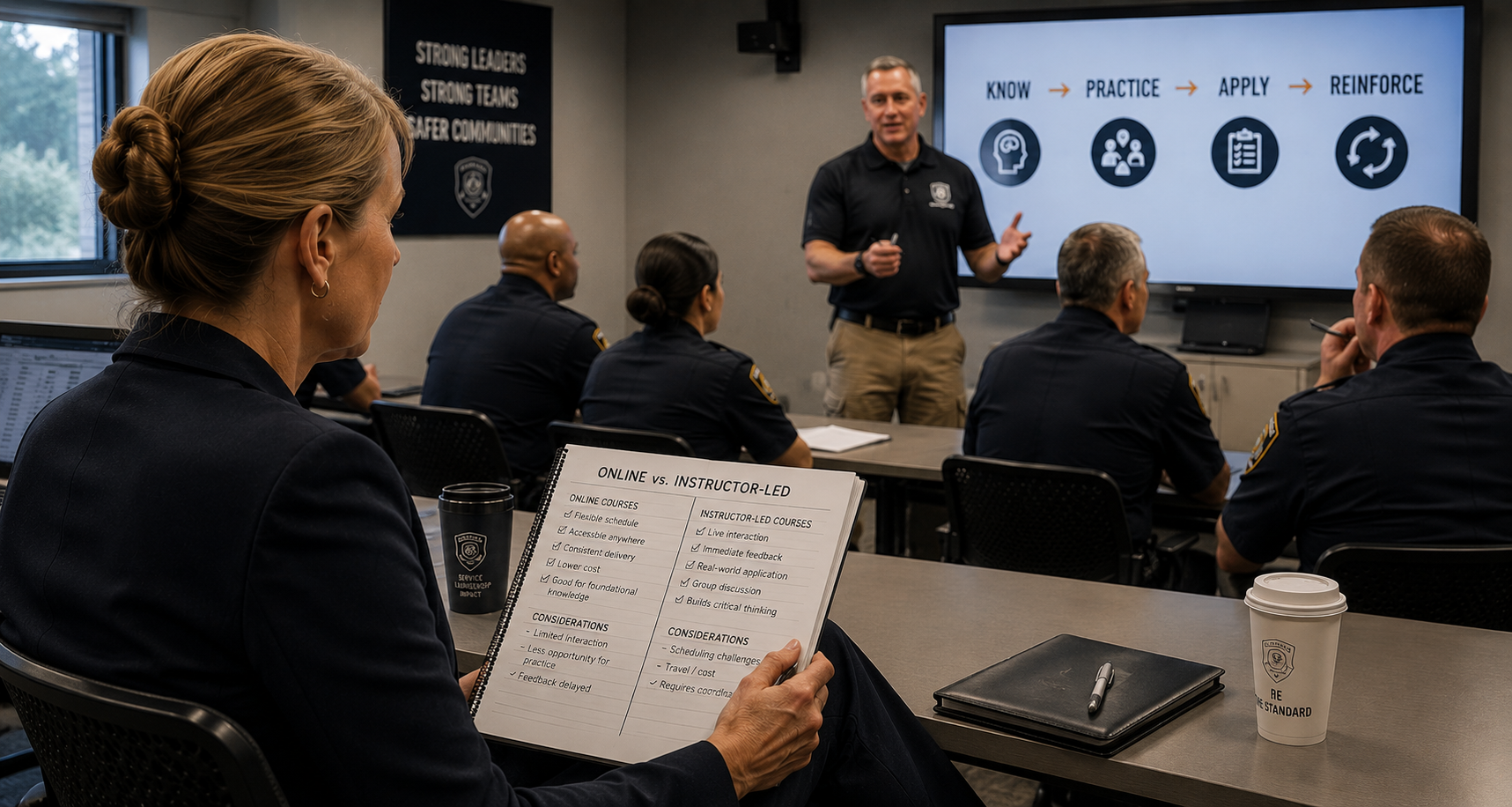
A useful way to think about effective training is:
Know → Practice → Apply → Reinforce
Know: Understand the concept or skill.
Practice: Work through how it applies to realistic situations.
Apply: Use the knowledge and judgment in the appropriate context.
Reinforce: Continue developing through leadership, feedback, and experience.
Not every subject requires the same approach. The key is matching the training method to the outcome.
Where Online Law Enforcement Training Works Well
Online training can solve real challenges for agencies.
Shift schedules make it difficult to put everyone in a classroom at the same time. Travel adds cost. Personnel may work across multiple facilities or locations, while training coordinators may need to deliver consistent information to large numbers of people.
Online learning can help address those challenges.
It can be particularly effective when the objective is to introduce or reinforce information, including foundational concepts, policy and procedural information, updates, refreshers, and other knowledge-based instruction.
Those are meaningful advantages.
The challenge begins when convenient delivery is treated as proof of effective learning.
A course can be accessible, scalable, and easy to complete without necessarily developing someone's ability to perform differently on the job.
Knowing What to Do Is Different From Being Able to Do It
Consider a newly promoted supervisor who understands the principles of accountability.
Then a high-performing officer who is well-liked by the squad begins ignoring an expectation. The supervisor has worked beside that officer for years, and the rest of the squad is watching.
Now the issue is no longer whether the supervisor can define accountability.
The issue is whether the supervisor can apply it.
How does the supervisor begin the conversation? How direct should they be? When is coaching appropriate? How do they preserve trust without avoiding responsibility?
Those are judgment and communication questions.
The same gap exists in de-escalation, decision-making, conflict management, and instructor development.
Knowledge tells people what a concept means. Practice and experience help them learn how to use it.
When Instructor-Led Law Enforcement Training Adds Value
Instructor-led training becomes particularly valuable when the learning objective requires interaction, judgment, practice, or feedback.
A capable instructor can do more than present material. They can ask questions, challenge assumptions, explore why participants reached a particular conclusion, and adjust a discussion based on what is happening in the room.
Participants also learn from one another. An experienced supervisor may recognize something a new sergeant has never encountered. A participant's question may open a discussion that helps the entire room see a problem differently.
Instructor-led training also creates opportunities for feedback on application.
When participants work through a scenario, decision, or difficult conversation, the instructor can help them examine not only what they decided, but why.
That reflection helps turn information into professional judgment.
Some Skills Require More Than Information
The distinction between information and application becomes especially important when training involves people.
Leadership is a clear example.
A supervisor can read about communication, accountability, emotional intelligence, coaching, and conflict management. But supervisors ultimately have to use those skills with real people, often under imperfect conditions.
That is why effective law enforcement leadership training should create opportunities to examine decisions, discuss difficult situations, learn from experienced instructors, and connect leadership principles to the realities of leading others.
The same principle applies to communication and de-escalation. Understanding a communication strategy is different from recognizing when and how to use it during a difficult encounter.
Information creates the foundation. Development happens when people learn what to do with it.
Online vs. Instructor-Led Law Enforcement Training
There is no single delivery format that fits every objective.
The word “varies” matters.
Online training is not one thing. An interactive virtual program is different from a passive recorded presentation. Likewise, putting people in a physical classroom does not automatically make training effective.
Format matters, but instructional quality matters more.
The Most Effective Approach May Be Blended
Agencies do not always have to choose between online and instructor-led training.
For some objectives, foundational information can be introduced before a classroom experience. Instructor-led training can then focus on discussion, application, scenarios, decision-making, and feedback.
Afterward, agency leaders can reinforce the concepts through coaching, mentoring, and expectations on the job.
The progression becomes:
Online or Pre-Learning → Instructor-Led Application → Agency Reinforcement
Training should be viewed as part of a development process rather than an isolated event. This is particularly important in leadership development, where agencies benefit from thinking beyond individual courses and considering how they are building a law enforcement leadership pipeline over time.
How Should Agencies Choose a Training Format?
Training coordinators and agency leaders should start with the desired outcome.
Before selecting a program, ask:
- What should participants be able to do afterward?
- Is the objective primarily knowledge or behavior development?
- Does the skill require practice?
- Would instructor or peer feedback improve learning?
- How important are discussion and real-world application?
- What staffing, scheduling, travel, and budget constraints exist?
- How will the agency reinforce the training afterward?
These questions move the decision beyond hours, cost, convenience, or delivery format and toward what the agency actually needs to improve.
Course Completion Is Not the Same as Training Effectiveness
A roster can show who attended. An online system can document who completed a module. A certificate can confirm that someone finished a course.
But completion does not necessarily answer the questions that matter most:
Did they learn it? Can they apply it? Did behavior or performance improve?
Depending on the objective, agencies might evaluate supervisor observations, follow-up conversations, scenario performance, behavioral changes, participant feedback, or operational outcomes.
Not every program will produce a simple metric. But agencies should define what success looks like before selecting the training.
What Should Agencies Look for in a Training Provider?
Delivery format is only one part of the evaluation.
Agencies should consider the instructor's relevant experience, the program's learning outcomes, opportunities for practical application, and whether the training matches the roles and responsibilities of the people attending.
Real-world experience does not replace sound instruction. But experienced instructors can help connect concepts to situations participants actually encounter.
Agencies comparing providers can use our practical checklist for evaluating a law enforcement training vendor to consider course quality, instructor experience, outcomes, and organizational fit.
Effective Training Continues After the Classroom
Even excellent training has limits if the organization does nothing with it afterward.
Participants return to existing habits, expectations, supervisors, and culture. Agency leaders can extend the value of training by discussing what participants learned, connecting concepts to current challenges, providing feedback, and modeling the same expectations they want others to follow.
That completes the framework:
Know → Practice → Apply → Reinforce
The training creates an opportunity for development. The organization helps sustain it.
Choose Training Based on the Outcome You Need
Online and instructor-led law enforcement training both have a place in professional development.
Online training can efficiently deliver information, expand access, and help agencies work around demanding schedules. Instructor-led training becomes particularly valuable when the desired outcome requires interaction, judgment, practice, feedback, or behavioral development.
The decision should not begin with which format is universally better.
It should begin with what the agency needs people to do differently when the training is over.
Effective law enforcement training moves beyond completing a course. It helps people turn knowledge into better decisions, stronger leadership, improved communication, and more effective service.
For agencies seeking practical, instructor-led professional development, explore Command Presence training opportunities.
Frequently Asked Questions About Law Enforcement Training
Is online law enforcement training effective?
Yes. Online training can work well for foundational knowledge, standardized information, updates, and refreshers. Skills requiring practice, judgment, interaction, or feedback may benefit from instructor-led or blended training.
Is instructor-led law enforcement training better than online training?
Neither format is always better. The right choice depends on the learning objective. Instructor-led training is especially valuable when participants need discussion, application, feedback, or interpersonal skill development.
What makes law enforcement training effective?
Effective training connects learning to job performance. A useful framework is Know → Practice → Apply → Reinforce: understand the material, practice it, apply it, and continue reinforcing it on the job.
What training benefits from instructor-led instruction?
Leadership, supervision, communication, de-escalation, decision-making, conflict management, and instructor development can benefit from live discussion, practice, and feedback.
How can agencies measure training effectiveness?
Look beyond attendance and completion. Agencies can evaluate practical application, supervisor observations, participant feedback, behavioral change, and relevant performance outcomes.
What is blended law enforcement training?
Blended training combines delivery methods—for example, online foundational learning followed by instructor-led application and agency-level reinforcement.