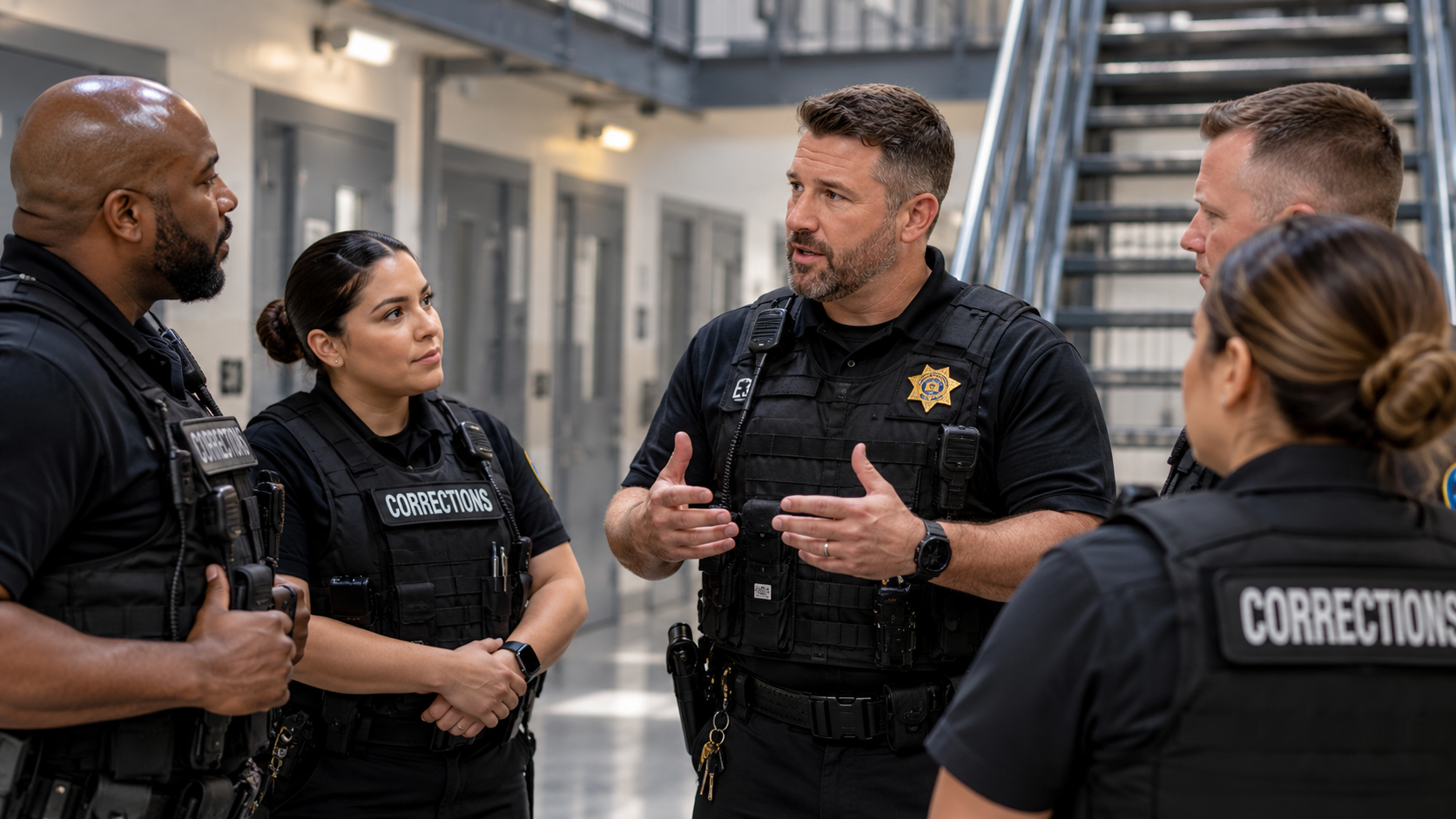
Correctional officer morale is tested by the realities of the job.
Staffing shortages. Overtime. Constant conflict. Difficult inmate interactions. Experienced officers carrying additional responsibilities while newer officers learn the job. Supervisors managing those same pressures while still being expected to maintain safety, standards, and performance.
A supervisor may not be able to change those conditions by the next shift.
But leadership still matters.
Correctional leaders strengthen morale by creating consistency, communicating clearly, enforcing standards fairly, recognizing meaningful work, supporting their people, and giving good officers opportunities to grow.
Morale is not about making a difficult job feel easy. It is about building an environment where correctional officers know what is expected, trust the people leading them, and believe their contribution matters.
What Affects Correctional Officer Morale?
Correctional officer morale is influenced by more than workload.
Staffing and overtime matter. So do the conditions officers experience every day:
- Inconsistent supervision
- Poor communication
- Uneven accountability
- Unrecognized effort
- Limited opportunities to develop
- Repeated reliance on the same dependable employees
- Lack of support during difficult situations
These issues tend to compound.
An officer can handle a difficult shift. What becomes harder to sustain is a difficult shift combined with unclear expectations, inconsistent leadership, and the belief that good performance makes little difference.
That is why corrections leadership has such a direct influence on morale.
Leaders cannot eliminate every stressor. They can determine whether their leadership creates additional friction or provides stability when the environment is already demanding.
Consistent Leadership Builds Trust
Correctional officers should not have to guess which version of the standard applies today.
They need to know what is expected, whether expectations apply across the team, and what will happen when performance falls short.
Consistency does not mean treating every situation identically. Good corrections supervisors still need judgment.
It means the standard remains recognizable.
When one officer is corrected for conduct that is ignored in another, people notice. When expectations change depending on which supervisor is working, officers learn to manage personalities instead of meeting a professional standard.
Trust erodes quickly when employees believe the rules depend on who is involved.
Your team can handle a difficult standard. What wears people down is a standard that keeps moving depending on who is working, who is supervising, or who made the mistake.
Set expectations clearly. Explain decisions when appropriate. Apply standards fairly. Follow through.
In an environment where officers already manage uncertainty, leadership should provide something they can count on.
Clear Communication Reduces Friction
Information moves quickly inside a correctional facility.
So does incomplete information.
When officers do not understand why something changed, what is expected, or what leadership is doing about a problem, assumptions fill the gap.
Supervisors do not need to have every answer.
They do need to communicate what they know.
"I don't have that answer yet. Here's what I do know."
That response is more credible than guessing, avoiding the issue, or allowing officers to hear important information through the rumor mill.
Communication also has to move up the chain.
Correctional officers often see operational problems before supervisors or command staff do. They know which processes repeatedly create friction, where communication breaks down, and what makes a difficult shift harder than it needs to be.
Ask them.
Then close the loop.
Not every concern can be resolved. Not every request can be granted. Sometimes the answer is no because of staffing, policy, resources, or operational needs.
Explain that when you can.
Being heard does not mean getting the answer you wanted. It means knowing your concern did not disappear when you raised it.
That distinction builds credibility.
Good Work Shouldn't Become Invisible
Some of the best correctional work attracts very little attention.
A conflict never escalates because an officer recognized the warning signs early.
A new officer avoids a mistake because an experienced employee stepped in.
A difficult inmate interaction remains professional.
A housing unit stays stable during a challenging shift.
Nothing dramatic happened.
That is often the point.
Supervisors need to recognize performance that might otherwise go unnoticed.
Make Recognition Specific
Generic praise is easy to give and easy to forget.
Specific recognition reinforces the behaviors you want repeated.
Instead of:
"Good job today."
Try:
"You saw that situation escalating early and slowed the interaction down before it became a larger problem. That's the kind of awareness we need on this shift."
Now the officer knows what mattered.
The people around them do, too.
People do not need constant praise. They need to know that good work is seen.
That is especially important for reliable employees whose performance becomes so consistent that everyone starts treating it as automatic.
It isn't.
Notice it.
Fair Accountability Protects Morale
There is a common mistake in conversations about morale: treating accountability as though it works against it.
Poor accountability can do far more damage.
High-performing correctional officers know who is doing the work. They know who can be counted on. They also know when poor performance is repeatedly ignored.
If dependable officers are held to a standard while others are allowed to fall below it, resentment grows.
Eventually, good employees start asking:
Why am I putting in this effort if the standard doesn't matter?
Fair accountability protects against that.
When performance needs to be addressed, keep the conversation focused:
Expectation → Behavior → Impact → Correction
What was expected?
What happened?
Why did it matter?
What needs to change?
Address the behavior rather than attacking the person. Be specific about the correction. Follow up.
The goal is not to win a difficult conversation. The goal is better performance.
For a deeper look at the relationship between standards and team culture, see Balancing Accountability and Morale in Your Squad.
Good morale does not require lower standards. It requires standards people believe are fair and meaningful.
Don't Let Reliability Become a Penalty
Every corrections supervisor knows the employee they can count on.
When staffing gets tight, they step up.
When a new officer needs help, they help.
When there is a difficult assignment, they handle it.
When something needs to get done, their name comes to mind.
That reliability is valuable.
It can also become expensive for the employee providing it.
The dependable officer gets another assignment because they can handle it. Then another. Then another.
Eventually, being good at the job can start to feel like being rewarded with more work.
Know Who Is Carrying the Team
Pay attention to patterns.
Who is consistently working overtime?
Who keeps receiving the difficult assignments?
Who is regularly mentoring newer officers?
Who gets called whenever something goes wrong?
Who used to volunteer and no longer does?
Who has become quieter, more frustrated, or less engaged?
A supervisor cannot always redistribute the workload. Correctional staffing realities may leave few options.
That does not make awareness irrelevant.
Talk to your people. Acknowledge what they are carrying. Redistribute responsibility where possible. Look for opportunities to develop other employees so the same people are not always carrying the team.
Don't wait until your most dependable officer stops volunteering to notice how much they have been carrying.
This is where morale, burnout, and retention begin to intersect.
Leadership Matters After a Difficult Incident
Correctional officers work in an environment where threats, violence, medical emergencies, self-harm incidents, and other high-stress situations can occur.
The immediate operational response matters.
So does what happens afterward.
Supervisors do not need to become counselors. They do need to remain engaged as leaders.
Depending on the circumstances, that may mean checking in with the officers involved, addressing immediate needs, making sure employees understand what resources are available, and following up after the incident has passed.
A quick "You good?" should not automatically be the end of the conversation.
The appropriate response depends on the incident, agency policy, available resources, and the needs of the employee. But leaders should not assume silence means no follow-up is needed.
Difficult incidents also expose whether supervisors are prepared to lead under pressure.
Command Presence's Leading When It Hits the Fan: Leading in Times of Crisis for Corrections focuses on developing corrections leaders for those moments when normal operations give way to crisis.
Preparation matters before the incident happens.
Leadership matters after it does.
Give Good Officers a Reason to Grow
One of the fastest ways for an employee to feel overlooked is to believe there is nowhere to go.
Not every correctional officer wants to promote.
Development still matters.
Officers can grow by:
- Mentoring newer employees
- Leading part of a shift briefing
- Becoming an instructor
- Taking ownership of a project
- Attending specialized training
- Developing communication and conflict-management skills
- Preparing for future supervisory responsibilities
These opportunities give employees a chance to contribute at a higher level while building capability within the organization.
They also help identify future leaders before the organization urgently needs them.
Leadership Development Should Start Before Promotion
Too many organizations begin developing leaders after someone receives rank.
By then, the employee is already being asked to lead people, manage conflict, communicate expectations, address performance, and make decisions under pressure.
Development should begin earlier.
Command Presence's Leading Without Rank in Corrections focuses on helping corrections professionals develop leadership and influence before formal authority arrives.
If the first time we intentionally develop someone as a leader is after the promotion, we started too late.
For the aspiring leader who wants to contribute more, development creates direction.
For the supervisor, it creates depth.
For the agency, it creates a stronger bench.
Correctional Leaders Should Focus on What They Can Influence
Corrections supervisors operate within constraints.
You may not control staffing vacancies.
You may not control mandatory overtime, budgets, every policy decision, organizational changes, or the difficulty of the environment.
Those realities matter.
But they do not eliminate a leader's influence.
You influence whether expectations are clear.
You influence whether accountability is consistent.
You influence how information is communicated.
You influence whether good work gets noticed.
You influence whether dependable employees are taken for granted.
You influence whether emerging leaders get opportunities to grow.
You influence how your people experience leadership when the job becomes difficult.
That is where supervisors should put their energy.
Morale does not require pretending the job isn't difficult. It requires leadership people can trust while doing a difficult job.
Stronger Correctional Teams Start With Leadership
Correctional officer morale is not created through one program or one conversation.
It develops through repeated experiences with leadership.
How was the standard communicated?
Was accountability fair?
Did someone notice the officer who stepped up?
Did the supervisor listen when a problem was raised?
Did leadership stay engaged after the difficult incident?
Does the employee see an opportunity to grow?
Those moments accumulate.
They shape whether officers trust their supervisors, whether good employees remain engaged, and whether emerging leaders see a future within the organization.
Command Presence's Corrections Series provides corrections-focused training for public safety professionals working in demanding environments where communication, leadership, and sound decision-making matter.
You may not be able to remove every pressure your officers face.
You can build the kind of leadership they can rely on while facing it.